Esta obra consiste en una adaptación del cuento popular Rumpelstiltskin de los Hermanos Grimm (1812), en el que una joven da objetos de valor e incluso llega a prometer su primer hijo para obtener un resultado inmediato: convertir la paja en oro. Aunque en el caso del cuento de popular podemos entender la necesidad de la joven, ya que si no consigue producir el oro será asesinada, cuando trasladamos esta historia a la actualidad, encontramos un extraño eco con nuestra relación respecto a la tecnología, en la que, sin ningún peligro inmediato de por medio, regalamos y comprometemos información sobre nuestra identidad a cambio de servicios tecnológicos que en el momento de ejecución parecen gratuitos o sin coste, pero en el que pagamos con un flujo de datos que pueden comprometernos en el futuro. A raíz de la lectura de La morfología del cuento de Vladimir Propp por parte de la artista, se traza en estas piezas los paralelos y repeticiones constantes que habitan en las historias y sucesos humanos, que no podemos escapar de las mismas estructuras narrativas.
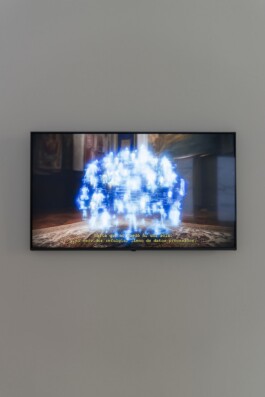
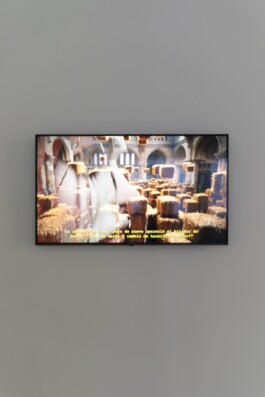
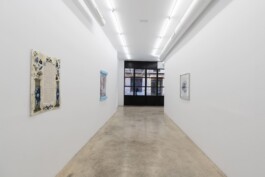
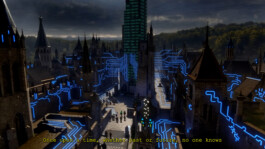
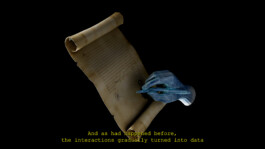
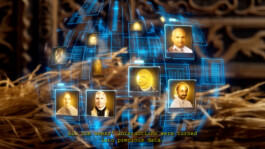
La obra consiste en dos piezas: la primera, un vídeo que reproduce de forma iconográfica esta versión actualizada del cuento, en el que los personajes son reinterpretados a través de una inteligencia artificial que permite trasladar texto a 3D. La segunda, una reescritura del cuento impresa en formato papel en el que los personajes también aparecen rodeando el texto como una guirnalda de carnaval digital. Este formato gráfico viene a imitar la combinación de texto e imagen de los códices religiosos y de las primeras impresiones de las colecciones de cuentos de los hermanos Grimm, para generar una hipótesis visual de los conceptos que unen las dos piezas: los seres humanos vivimos en un loop cerrado de programación, que nos condena a protagonizar las mismas historias, una y otra vez.
ENG - A very long tale (2026)
This work consists of an adaptation of the fairy tale Rumpelstiltskin by the Brothers Grimm (1812), in which a young woman gives away valuable objects and even goes so far as to promise her firstborn child in order to obtain an immediate result: turning straw into gold. Although in the case of the fairy tale we can understand the young woman's necessity, since if she fails to produce the gold she will be killed, when we transpose this story to the present day, we find a strange echo in our relationship with technology. In this modern context, without any immediate danger involved, we give away and compromise information about our identity in exchange for technological services that at the moment of use seem free or without cost, but for which we pay with a flow of data that may compromise us in the future.
Following the artist's reading of Vladimir Propp's *Morphology of the Folktale*, these pieces trace the constant parallels and repetitions that inhabit human stories and events, revealing that we cannot escape the same narrative structures.
The work consists of two pieces: the first is a video that iconographically reproduces this updated version of the tale, in which the characters are reinterpreted through an artificial intelligence that allows text to be translated into 3D. The second is a rewriting of the tale printed on paper, in which the characters also appear surrounding the text like a digital carnival garland. This graphic format imitates the combination of text and image found in religious codices and the early printed editions of the Brothers Grimm's fairy tale collections, in order to generate a visual hypothesis of the concepts that unite the two pieces: human beings live in a closed programming loop, which condemns us to star in the same stories, over and over again.